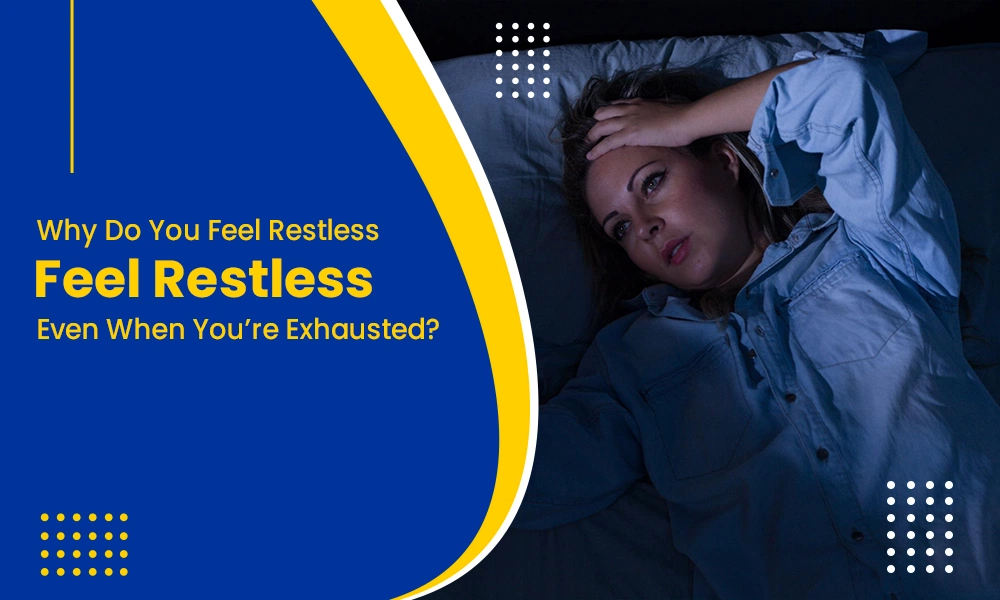
You know those days when you want nothing more than to just crawl under your covers, maybe have some tea in bed, and then doomscroll. The week has been extremely exhausting, and you’re at the end of the metaphorical rope. But by the time you do manage to get into your PJs and get in bed, you’re suddenly left wide awake.
It doesn’t matter if you shift positions, check the time, or turn the pillow over. Somehow nothing works, and you know that by tomorrow morning, you will just feel more tired. So, why do we sometimes feel restless despite being bone tired? Sometimes the brain and body struggle to switch off from an alert stage. Stuff like an irregular schedule, stimulants, sleep disorders, or a disrupted circadian cycle can all affect their ability to switch to a relaxed state and make you feel restless.
In the blog below, we aim to help walk our readers through the stressful experience and hope to equip them with more information at the end of it.
What Does It Mean To Feel Restless At Night?
If someone says that they feel restless at night, it doesn’t always mean that they cannot physically stay still. For some people, it may look like constant tossing and turning, checking the clock repeatedly, or having racing thoughts.
Making this clear is important since several people think that feeling restless at night immediately means that someone did not sleep for N amount of hours. Sleep quality is not directly correlated to the amount of hours you get in bed. The CDC states that a good sleep is one that has enough hours and also good quality.
People between the ages of 18 and 60 and medical professionals have generally recommended around 7 hours in terms of duration. That’s where a more complex comprehension of restless sleep comes in. You may be sleeping for 7-8 hours, but if in those hours, your body is entering awake states frequently due to restlessness, then the quality of your sleep goes down.
In 2024, a survey was done on U.S. adults, and it was found that around 30.5% of adults were not hitting the 7-hour mark of their sleep duration and thus might feel restless due to poor sleep quality.
Why Do You Feel Restless Even If You’re Exhausted?
One of the most common answers to this question is typically being in a state of hyperarousal. Some professionals also use the term “adrenal fatigue.”
During the day, your alertness levels are operating as usual. Your brain is in an alert mode because you have to attend to your deadlines, traffic, notifications, and conversations around you. While staying alert is extremely important when you’re awake and around people, this same mechanism needs to quiet down when you start to wind down at the end of the day. If your mind keeps spending time thinking of tomorrow’s deadlines or meetings, your body finds it unable to relax as well.
Research has shown that symptoms like daytime fatigue or daytime sleepiness are highly associated with insomnia or hyperarousal at night. In a study done on around 317 individuals, almost half had insomnia,, and the other half were healthy. It was found that individuals who had insomnia had significantly higher instances of experiencing hyperarousal and daytime tiredness and were mostly tired in the morning despite getting enough hours of sleep.
People who have trouble maintaining a consistent sleep-wake cycle also have more anxieties as they near nighttime, which can create a catch-22 situation for most people where they feel restless during nighttime and do not get good sleep, which is why their brain may race and make it all the more difficult for them to get better sleep the following night. It becomes a loop.
Your Sleep Cycle May Be Out of Sync
All of our bodies have independent internal clocks within which help our body decide when to sleep and when not to. It’s not always about how tired you are.
We have a 24-hour biological clock in our bodies, which is called the circadian rhythm. This rhythm helps regulate and coordinate our sleep, wakefulness, body temperature, and even our hormones. Having bright lights on late at night, inconsistent bedtime, or sleeping very late on weekends can all throw this rhythm in for a toss and lead to unrefreshing sleep and persistent tiredness throughout the day.
This is why sometimes you may feel so tired and exhausted at 9 pm but wide awake at midnight. Trying to have a consistent sleep-wake cycle, getting natural light as soon as you wake up, and reducing your exposure to bright light later in the day can all help you establish a better circadian rhythm.
Sometimes, some individuals experience long-term circadian rhythm sleep-wake disorders, which can also make it difficult for them to sleep and wake up at consistent times. In these situations, they should consult a medical professional.
Caffeine and Screen Time
Sometimes the reason you may feel restless at night could be due to something completely ordinary.
You may have had a late-afternoon coffee, energy drink, or pre-workout supplement or scrolled too much on your phone, which can all keep the brain alert and make it difficult for individuals to get a good night’s sleep.
Having a consistent evening schedule is also important. If your brain is habituated and thinks that evening time means scrolling, working, gaming, or watching series, then your bedroom may stop being a cue for it to be relaxed but make it stay alert. It all comes down to help build a relaxing environment for your brain.
Can Medications Help You Stay Alert?
Absolutely. There are certain modafinil medications available on the market that can make it possible for you to fight your daytime sleepiness and fatigue that stem from nighttime restlessness.
Medications like Modalert 100 mg and Modalert 200 mg are given to individuals who experience extreme daytime sleepiness due to sleep-wake disorders like narcolepsy, obstructive sleep apnea (OSA), or shift-work disorder. In these cases, Modalert engages with their dopaminergic system and increases its levels in the brain. This process can make it easier for individuals to stay awake.
While these medications do help those in need of it, they cannot directly resolve nighttime restlessness. Taking these medications late in the night and without professional guidance can also make someone feel restless, which will prove to be completely counterintuitive. That’s why you should always take these medications under the guidance of a professional and try to set a consistent schedule to resolve your restlessness.
Wrapping Up
See, occasional restlessness here and there is fine. The problem is when you start experiencing it on a daily basis and it keeps interfering with the quality of your sleep.
If something has become that pervasive, then it’s best to speak to your healthcare provider and try to look for solutions together. Keeping a sleep diary can help where you briefly write down your schedule and sleep quality so that can help you keep track of your restless nights.
Monitoring your caffeine intake, sleep-wake times, and also screen time can again help you get a clearer picture. At the end of the day, your goal isn’t to spend more time in bed but also get quality sleep at the end of the day.
Frequently Asked Questions
1. Is it normal to feel restless when completely exhausted?
Yes, it’s common, often from stress, an off body clock, or caffeine. If it keeps going, see a doctor.
2. Can a sleep disorder make someone feel restless at night?
Yes. Sleep apnea, restless legs, and insomnia are the usual suspects.
3.Is Modalert meant for restlessness?
Modalert 100 mg and Modalert 200 mg are sleepiness promoting medicines and are indicated for excessive sleepiness and not general restlessness.
4. What separates Modalert 100 mg from Modalert 200 mg?
Strength, mainly. Your healthcare provider can help you pick the one based on the condition and how you respond to it.
5. When should someone see a doctor about this?
When it drags on for weeks or comes with loud snoring, leg urges, or heavy daytime sleepiness.