Ever wonder why you can feel super awake at 11pm on a Sunday night but can hardly keep your eyes open in a Monday morning meeting? If you have chronic obstructive pulmonary disease (COPD), the sensation may be familiar to you. Often the problem is not that the lungs have ceased working but that the airways have narrowed and are making it tougher for air to get in and out. This is where a recommended bronchodilator can make you feel a difference.
Or why sleeping in on the weekends can somehow make Monday feel like jet lag?
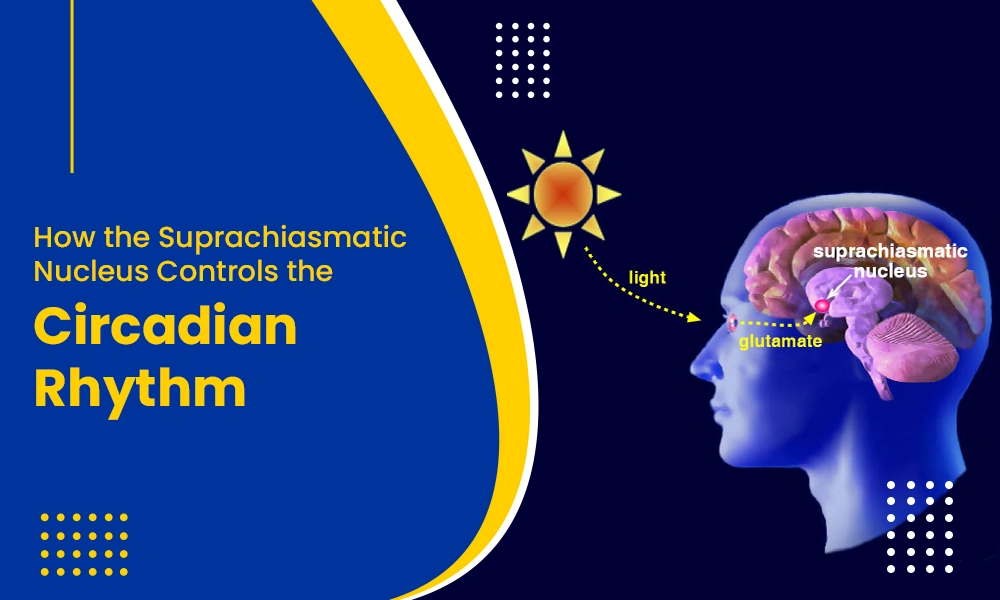
It’s not merely about being weary. Deep in the brain, a tiny cluster of cells is watching what time it is for you to be awake, drowsy or hungry, and when specific hormones should go up or down. This biological clock is called the suprachiasmatic nucleus, or SCN for short.
The suprachiasmatic nucleus in the brain is the major circadian clock. It is essential for setting the body’s internal clock to the 24-hour day, mostly in response to cues from light entering the eyes. When the timing system is regularly exposed to daylight during the day and darkness at night, sleep and wakefulness tend to settle into a predictable rhythm. When those signals get scrambled, the clock can get out of whack.
What Is the Suprachiasmatic Nucleus?
The suprachiasmatic nucleus (SCN) sits in the hypothalamus, just above the optic chiasm, hence the name, “supra,” meaning above. It’s paired, so there are really two of them, one on each side of the third ventricle. Together they’re smaller than a grain of rice. Kind of wild that something so small runs the timing for basically every organ system in the body.
People ask sometimes, “What controls the human circadian rhythm?” expecting some complicated answer involving hormones or the pineal gland or whatever. And sure, those things matter. But the actual command center, the thing calling the shots, is this small nucleus tucked into the hypothalamus.
Once you know that, it explains a lot of things like jet lag, shift work fatigue, or that weird 2pm slump. All of it traces back to this one structure trying to keep time.
How does the SCN work?
This is where it gets a little more technical, though not in a way that needs a biology degree to follow.
Inside the SCN, individual cells run their own little internal clocks using something called clock genes, Per and Cry genes mostly, if anyone’s curious. These genes turn on and off in a loop that takes roughly 24 hours to complete. Not exactly 24 hours, usually a little more or a little less, which is actually the whole reason light matters so much.
Because left alone, without any outside cues, the SCN would just drift. Slowly get out of sync with the actual day-night cycle. That’s why it needs light. Real, actual daylight hitting the retina.
There’s a direct pathway from specialized cells in the retina straight to the SCN, the retinohypothalamic tract, if you want the technical term, though nobody outside a lecture hall uses that phrase. Light exposure and sleep are connected precisely because of this pathway. Morning light hits the eyes, signals travel to the SCN, and the whole system recalibrates itself to match the actual time of day.
This is basically how the SCN controls sleep, not by flipping some sleep switch, but by constantly adjusting its internal timing based on light input, then broadcasting that timing out to the rest of the body
Melatonin and the SCN
The suprachiasmatic nucleus and circadian rhythm regulation don’t happen in isolation. Once the SCN has its timing sorted out, it sends signals to other parts of the brain and body, the pineal gland being one of the big ones. That’s where melatonin gets released, usually starting a couple hours before a person’s normal bedtime, dropping off again closer to morning.
This is probably the connection most people have actually heard of. Melatonin supplements exist because of this exact pathway, the idea being that if the SCN’s timing is off, or if someone’s dealing with jet lag or shift work, giving the body a little external melatonin can help nudge things back into rhythm. It’s not a perfect fix and doesn’t work the same for everyone, but the logic traces directly back to how the SCN talks to the pineal gland.
Beyond sleep, the SCN also has fingers in body temperature, cortisol release, digestion timing, and even how alert or sluggish someone feels at different points in the day. Pretty much anything with a daily up-and-down pattern has the SCN’s signature on it somewhere.
Effects of Irregular Sleep
An irregular sleep schedule and circadian rhythm mismatch is basically asking for trouble. Staying up late one night, sleeping in the next, pulling an all-nighter the week after, every one of these throws off the timing signals the SCN is trying to send out.
The SCN doesn’t really care what a person’s calendar says. It runs on light and darkness, mostly. So a person who works nights and sleeps during the day is essentially fighting their own biology every single shift. The SCN keeps trying to push wakefulness during daylight hours because, well, that’s what it’s built to do.
This is part of why circadian rhythm and sleep problems are so common in shift workers, people who travel a lot across time zones, or honestly just anyone who scrolls on a bright phone screen at 1am and wonders why they can’t fall asleep. Blue light in particular seems to interfere with the retinal signals heading to the SCN, tricking it into thinking it’s still daytime.
How Does Light Affect the Circadian Rhythm?
How light affects circadian rhythm keeps coming up because it’s genuinely the single biggest external factor in this whole system. Bright light in the morning, actual sunlight if possible, helps set the SCN to the correct phase for the day. Dim light in the evening lets it wind down properly.
People who spend all day indoors under artificial lighting sometimes end up with a weaker signal reaching the SCN, which can lead to more fragmented, lower-quality sleep even if they’re technically getting enough hours in bed.
Not everyone responds to light the same way either. Some people are naturally more sensitive to evening light than others. Age plays a role too, older adults often produce less melatonin and can have a suprachiasmatic nucleus function in sleep regulation that’s just generally weaker than it used to be, which is part of why sleep patterns shift as people get older.
SCN and Sleep-Wake Cycle
SCN and its mechanisms are really one of the main contributors towards the regulation of your sleep cycle. Without it, the body would still sleep and wake, probably, but the timing would be chaotic. Studies on animals with a damaged SCN show exactly this, the rhythm doesn’t disappear but just becomes scattered and unpredictable, no longer tied to any consistent 24-hour pattern.
Humans with disrupted SCN signaling, whether from age, illness, or something like severe jet lag, often describe feeling like their sleep is just randomly scattered across the day instead of consolidated into one solid block at night. That scattering is basically what happens when the master clock loses its grip on the rest of the body.
For people dealing with ongoing sleep issues tied to this kind of disruption, some end up looking into melatonin-based options as a way to support the body’s own signaling rather than replace it entirely. It’s less about forcing sleep and more about giving the SCN a clearer signal to work with, especially when natural light exposure has been inconsistent.
Final Thoughts
Several people wonder if knowing all this can actually help someone sleep better, and yeah, maybe it can. Understanding how the SCN actually runs the show doesn’t automatically fix a bad sleep schedule. But it does explain why some fixes work better than others. Getting morning sunlight actually does something measurable. Staring at a phone at midnight actually does interfere with the system, not just in a vague “screens are bad” way but in a specific, traceable, light-hits-retina-signals-SCN kind of way.
The suprachiasmatic nucleus isn’t going anywhere, and it’s not particularly flexible about how it works. It wants consistency, real light cues, and a reasonably predictable schedule. Give it that, and the whole downstream system, such as melatonin, temperature, and alertness, tend to fall into line on its own.
Frequently Asked Questions
1. What is the suprachiasmatic nucleus in simple terms?
It’s a small cluster of brain cells that acts as the body’s master clock, keeping sleep and other daily rhythms on a roughly 24-hour schedule.
2. Where is the suprachiasmatic nucleus located?
It sits in the hypothalamus, just above the optic chiasm, which is why it got that name in the first place.
3. Can the suprachiasmatic nucleus be reset?
Sort of, consistent light exposure, especially in the morning, can help shift its timing, though it takes a few days usually, not overnight.
4. Does the suprachiasmatic nucleus control melatonin directly?
Not directly, but it tells the pineal gland when to release melatonin, so they are closely related.
5. What happens if the suprachiasmatic nucleus is damaged?
If the suprachiasmatic nucleus gets damaged, then sleep and other daily physiological rhythms become irregular and unpredictable. Because of the damage, they don’t follow the typical 24-hour pattern anymore.