You switch off your lights, put your phone on Do Not Disturb, and wear your eye mask, all set to go to sleep, but you just end up finding yourself counting sheep a few hours later. Why does that happen? Why does our mind keep racing and slipping just out of our reach? Why do we end up replaying every conversation or argument that we have had in the last 10 years? Maybe your mind has already jumped to the day after and you are going through that to-do list. Of course, there are a number of things that might be causing this problem, but it could also be the very same device you use to wind down before bed.
Research professionals have spent several years figuring out how blue light affects sleep, and the findings have been able to give us a clearer picture of the situation. We talk about this experience at length in this article and attempt at giving you a better glimpse at how the situation works. It’s not about being “too stimulated” by the content, it’s about what the light itself is doing to the brain.
What is the blue light doing?
Screens, phones, tablets, laptops, and even some TVs emit a lot of light in the blue wavelength range, somewhere around 400 to 500 nanometres if you want the technical number. That range happens to be the one human eyes are most sensitive to when it comes to telling the brain whether it’s day or night. Not red light, not yellow light. Blue light specifically.
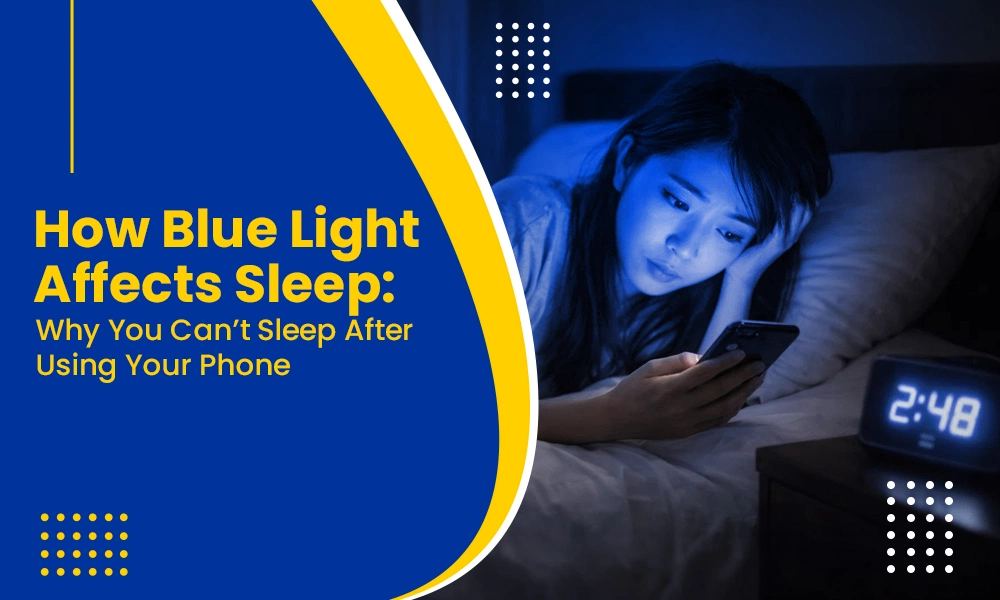
This is really the starting point for how blue light affects sleep, there are cells in the retina, separate from the ones used for actual vision, that respond to this wavelength and send a signal straight to the part of the brain that runs the internal clock. So when someone’s scrolling at 11pm with the brightness cranked up, the brain is quite literally being told it’s daytime. That’s the blunt version of why blue light affects sleep the way it does.
Melatonin production takes the hit
The hormone responsible for making a person feel sleepy is melatonin, and it’s produced by the pineal gland once it gets the “it’s dark now” signal. Blue light delays or straight-up blocks that signal. This is basically the clearest proof point for how blue light affects sleep on a hormonal level. Research on this has been fairly consistent, with some studies showing melatonin staying suppressed for hours after exposure, even after the screen goes off. So even if someone puts the phone down at midnight, their body might not start winding down until much later than it normally would.
This is one of the clearer explanations for insomnia from screen time. It’s not that people are anxious from their notifications (though that doesn’t help either), it’s that the actual biology of falling asleep has been pushed back.
The body clock doesn’t reset that fast
The body runs on roughly a 24-hour internal clock, the circadian rhythm, and it’s stubborn. It doesn’t just snap back into place the moment you close Instagram. Repeated late-night blue light before bed exposure can shift that rhythm night after night, and eventually the body starts expecting to be awake later and later. This is basically how people end up with a delayed sleep schedule without meaning to. Bedtime creeps from 11 to midnight to 1am over a few weeks, and nobody really notices it happening in real time.
Some people think weekends will “fix” it, sleeping in to catch up. It kind of doesn’t work like that, though, since blue light affects sleep timing on a nightly basis, not a weekly one. The shift just gets confirmed again the next night when the phone comes back out.
Does the type of screen matter?
A little, not hugely. Phone use before sleep is probably the worst offender just because phones are held close to the face, screens are bright relative to the distance, and people tend to use them lying flat in the dark, which makes the contrast even sharper on the eyes. A laptop across the room in a lit room is a different story than a phone six inches from your face in total darkness.
Night mode or “warm” filters on phones reduce blue wavelength output somewhat, but they don’t eliminate it, and honestly, most people don’t turn it on until way too late anyway. It softens how blue light affects sleep, it doesn’t cancel it out.
People sometimes think the issue is only “Can I fall asleep or not?”, but sleep quality also gets affected even in cases where someone does eventually drift off. Disrupted melatonin timing has been linked to lighter, more fragmented sleep, more waking up in the middle of the night, and less time in the deeper restorative stages. So someone might technically get seven hours in bed and still wake up groggy, because the sleep itself wasn’t as solid as it looked on paper, which is another way of saying blue light affects sleep depth, not just sleep timing.
The role of individual habits
Sleep hygiene is basically the umbrella term for all the small habits that either help or wreck sleep, and screen use before bed sits right near the top of the list of things that wreck it. Dimming lights an hour or two before bed, keeping the bedroom for actual sleeping rather than scrolling, and cutting off screens earlier are the usual advice. It’s not glamorous advice, and it’s also genuinely hard to follow when the phone is right there, even once someone actually understands blue light affects sleep and why it matters.
Screen time and sleep have basically become tangled together at this point because devices are just always around, work emails, group chats, doomscrolling news, whatever it is. Cutting it out entirely isn’t realistic for most people, so smaller adjustments tend to matter more in practice.
Wakefulness medications
This is a slightly different angle, but worth mentioning. There’s a separate category of medications, modafinil and armodafinil among them, that are prescribed for excessive daytime sleepiness related to conditions like narcolepsy, shift work disorder, or sleep apnea. These aren’t sleep aids, but they rather work in the opposite direction, promoting wakefulness by acting on certain neurotransmitter pathways in the brain rather than by suppressing melatonin the way blue light does.
The reason they come up in this conversation at all is timing. Someone dealing with body-clock disruption from screens, poor sleep habits, or irregular schedules might end up feeling excessively sleepy during the day as a downstream effect. Armodafinil in particular has a longer half-life than standard modafinil, so its wakefulness effects tend to stretch further into the day for people managing that kind of fatigue. Neither of these medications should be treated as a fix for a screen habit, though. They’re prescription tools for specific diagnosed conditions, not something to reach for because bedtime scrolling wrecked last night’s sleep.
Final Thoughts
You might be wondering if it would really affect your sleep if you used the phone for a night, and probably not. The bigger issue is when late-night phone use becomes the default, night after night, because that’s when the shift actually compounds. One late night probably won’t do much. Months of it will.
Here’s some stuff that can help. Keeping your phone across the room instead of on the pillow. Some kind of cutoff time, even a loose one. Dimmer lighting generally in the evening, not just on the phone. None of this undoes the fact that blue light affects sleep the way it does, but it reduces how much exposure actually reaches the eyes close to bedtime, which seems to be the part that matters most.
Frequently Asked Questions
1. Does blue light actually delay sleep, or is that overstated?
It’s very real and researched. The way blue light affects sleep is by delaying melatonin release and pushing back when the body feels ready for sleep.
2. How long before bed should screens be avoided?
Most sleep researchers suggest around one to two hours, though even shorter breaks help somewhat.
3. Do blue-light glasses actually work?
They can reduce exposure to some degree, but they’re not a complete fix for late-night screen habits.
4. Can poor sleep from screens cause daytime sleepiness?
Yes, disrupted melatonin and body clock timing often show up the next day as grogginess or low energy.
5. Are modafinil and armodafinil used to fix screen-related sleep problems?
Modafinil and Armodafinil can be used in the conditions of narcolepsy, Obstructive sleep apnea and shift-work disorder but doesn’t play a role in fixing screen-related sleeping issues.