Almost everyone has had a morning where the alarm goes off and the body simply refuses. A late night, too much scrolling, a noisy neighbour, fine. That is normal enough. The odd part is when it keeps happening, week after week, despite eight hours in bed on paper. At some point the explanation stops being “busy life” and starts looking like a medical question. One of the more common answers is a breathing disorder that only really shows itself in the dark. A frequently cited 2019 estimate suggested something like 936 million adults aged 30 to 69 worldwide might have it in some form, counting the mild cases. Whether that number is perfect is debatable, since prevalence studies are messy and definitions keep shifting, but even the cautious versions are large. A big share of those people have never been tested, which is partly the point of this piece.
Starting with the basics
So, what is sleep apnea? In plain terms, it is a condition where breathing repeatedly stops or becomes very shallow during sleep. “Apnea” comes from the Greek for “without breath”, and a pause is generally counted once it lasts ten seconds or more. Partial blockages, called hypopneas, get counted too. Clinicians add up both and express the total as the apnea-hypopnea index (AHI), meaning events per hour. Below 5 is considered normal, 5 to 15 is mild, 15 to 30 moderate, and above 30 is considered severe. Those cut-offs are a bit arbitrary, and some people with a “mild” score feel dreadful while others with a severe score barely notice anything. The numbers matter less than they look like they should.
Two types, though one gets most of the attention
Obstructive sleep apnea (OSA) is the big one. The throat muscles relax, the airway narrows or collapses, and air struggles to get through even though the chest keeps trying. Central apnea is different, and rarer. The brain temporarily fails to send the signal to breathe, so there is no effort at all. Some people have a mix. Most of what follows concerns the obstructive kind, usually shortened to OSA, since that is what the majority of adults are dealing with, though the warning signs overlap a lot.
Pathophysiology, but in plain words
During sleep the tongue and soft palate sag backwards a little. In most people that is harmless. In others the airway is already narrow, so the sag is enough to shut it, or nearly. Oxygen levels dip, carbon dioxide creeps up, and the brain responds with a brief arousal, a micro-awakening, just enough to tighten the muscles and reopen the airway. Usually there is a gasp or a snort. Then sleep resumes, and the whole thing can repeat dozens or even hundreds of times in a night. The person typically remembers none of it.
That fragmentation is arguably the real problem, perhaps more than the oxygen dips alone, or maybe equally, since the research is still sorting out which matters most. REM sleep tends to be hit hard, because muscle tone is at its lowest in that stage, so events cluster there and the dreaming phase gets chopped up. Each arousal also triggers a small surge of stress hormones and a rise in heart rate and blood pressure. Repeat that all night and the body never gets the rest it thinks it is getting. Which explains how someone can spend eight hours in bed and still end up with poor sleep quality.
Early signs of sleep apnea that get brushed off
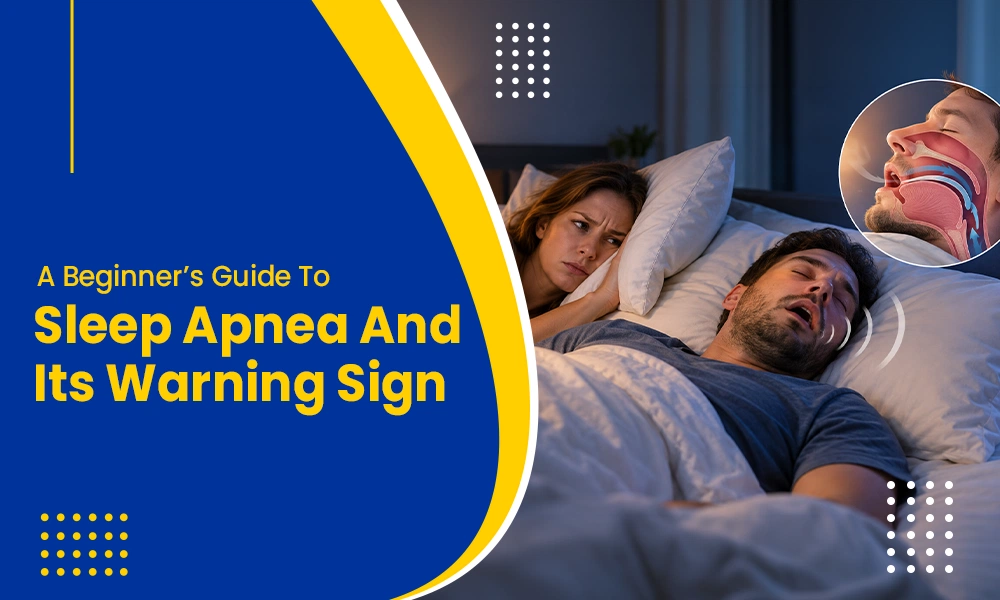
Loud snoring is the one everybody knows, and it is a genuine red flag, particularly when it is interrupted by silence and then a choking or gasping sound. Often a bed partner notices the nighttime breathing problems first and describes pauses in breathing during sleep that the sleeper has no idea about. Sometimes the partner is more worried than the patient. But not everyone snores, and not every snorer has the condition, which makes the sign useful and unreliable at the same time. Annoying, really.
Other clues show up in the morning. Waking up tired is a big one, along with a dry mouth, a sore throat, or a dull headache that fades after an hour or so. Frequent night-time trips to the toilet turn up more than expected, probably because pressure changes in the chest alter hormone signalling that influences the kidneys. During the day, daytime sleepiness can creep in, the kind where the eyes close in a meeting or on the train, and driving becomes a bit risky. Concentration slips, mood gets flatter or snappier. People tend to put all of it down to age, stress, or the job.
Clinical presentation: symptoms that overlap with everything
A tricky thing about the symptoms is how general they are. Fatigue and sleepiness are not the same, though they get lumped together. Fatigue is a lack of energy, a heavy sort of exhaustion, while sleepiness is the actual tendency to doze off. OSA classically produces sleepiness, but plenty of people, women especially, mainly report fatigue, low mood, insomnia and morning headaches instead. They end up missed, or labelled with depression or anxiety. Studies suggest women are underdiagnosed for exactly this reason, the textbook picture having been modelled largely on middle-aged men.
Then there is sleep inertia, the groggy, slow, slightly confused stretch just after waking. Everyone gets some of it, usually for fifteen to thirty minutes. If the fog drags on much longer, or comes with everything above, it deserves a mention to a physician. It might be nothing. It might be the broken sleep architecture again.
Sleep apnea causes, or the usual suspects
There is no single cause, which is irritating for anyone wanting a clean answer. Anatomy is a large part: a narrow airway, a recessed jaw, big tonsils, a thick tongue, a long soft palate. Some of that is inherited, so it tends to run in families. Excess weight adds fat around the neck and upper airway and reduces lung volume, which makes collapse more likely, though slim people get OSA too, and that surprises many of them. Age matters because the throat muscles lose tone over time. Alcohol and sedatives relax those muscles further, which is why a heavy night out can turn mild snoring into proper obstruction. Nasal congestion, lying flat on the back, and hormonal changes after the menopause also play a role. Probably a few of these overlap in any given person.
Risk factors and epidemiology
The commonly listed sleep apnea risk factors are fairly predictable: being male, being over 40, carrying extra weight, a larger neck (above roughly 40 cm is a common screening threshold), smoking, regular alcohol use, a family history, and conditions such as high blood pressure, type 2 diabetes, atrial fibrillation and heart failure. Rates climb in women after the menopause, narrowing the gap with men.
Sleep apnea in adults is also heavily underdiagnosed. Depending on the country and the study, a large majority of moderate-to-severe cases are thought to go unrecognised. That is a rough statement, and the figures do vary across Europe, since access to sleep clinics is quite uneven, but the general direction is consistent.
Circadian rhythm, blue light, and other sleep disorders
The body clock, the circadian rhythm, governs when sleepiness rises and falls, and anything that nudges it later, such as bright screens in the evening, tends to shave time off sleep. Blue light exposure before bed suppresses melatonin a little, though how much that matters in real life is still argued over, and the effect is probably smaller than the headlines suggest. It does not cause OSA. What it can do is stack extra poor sleep on top of an existing problem, which makes it harder to know what is responsible for the tiredness.
That overlap is common among sleep disorders generally. Insomnia, restless legs, shift-work patterns and OSA frequently coexist, and the combination of insomnia plus OSA appears to be more common than once believed. Treating one while ignoring the other tends to give disappointing results.
Sleep apnea diagnosis: what the process looks like
It usually begins with a few questions, and perhaps a questionnaire such as the Epworth Sleepiness Scale or STOP-Bang. If suspicion is high, a referral to a sleep service follows. Testing can be a home study, with a finger oximeter or a small device measuring airflow and breathing effort, or an overnight stay in a lab for full polysomnography, which records brain activity, eye movements, heart rhythm, oxygen levels and more. Home tests are cheaper and easier but can miss milder or more complex cases. Waiting times differ a lot between European countries, and even within them, which is frustrating. In the meantime there is not much to do except avoid alcohol late in the evening and avoid driving when drowsy.
What treatment looks like
Sleep apnea treatment depends on severity and on what the person can actually tolerate. For moderate to severe OSA, continuous positive airway pressure (CPAP) is the standard first choice. A mask delivers a gentle stream of air that keeps the airway open. It works well when used, and that “when used” is doing a lot of work, because plenty of people struggle with the mask at first. Mouthpieces that move the lower jaw forward suit milder cases. Weight loss can reduce severity quite a lot, sleeping on the side helps some, and cutting back alcohol helps nearly everyone. Surgery and nerve stimulation devices exist for selected patients. Medications that consist of Modafinil or Armodafinil are also being used for OSA. Few of the medications that are used majorly are Armodacare 250 mg, Modalert 100 mg and Waklert 150 mg.
Left untreated, the condition is linked with high blood pressure, heart disease, stroke, type 2 diabetes and road accidents, which is a good reason to get tested rather than just putting up with it. Then again, that makes it sound apocalyptic, and for many people treatment is fairly straightforward and the change almost embarrassingly noticeable. The energy comes back, the headaches go.
Frequently Asked Questions
1. Can sleep apnea happen without snoring?
Yes. Snoring is common but not universal, and quieter cases still fragment sleep.
2. Is sleep apnea dangerous?
It can be, mainly through links to high blood pressure, heart problems and drowsy accidents, especially when untreated.
3. Can sleep apnea go away on its own?
Rarely in full. Weight loss and lifestyle changes can ease it, but a proper check is still worth doing.
4. When should someone see a physician?
When loud snoring, witnessed pauses in breathing or constant tiredness have lasted a few weeks.
5. Does a sleep test hurt?
No. Home tests use small sensors, and lab tests only involve stick-on pads and a bit of wiring.