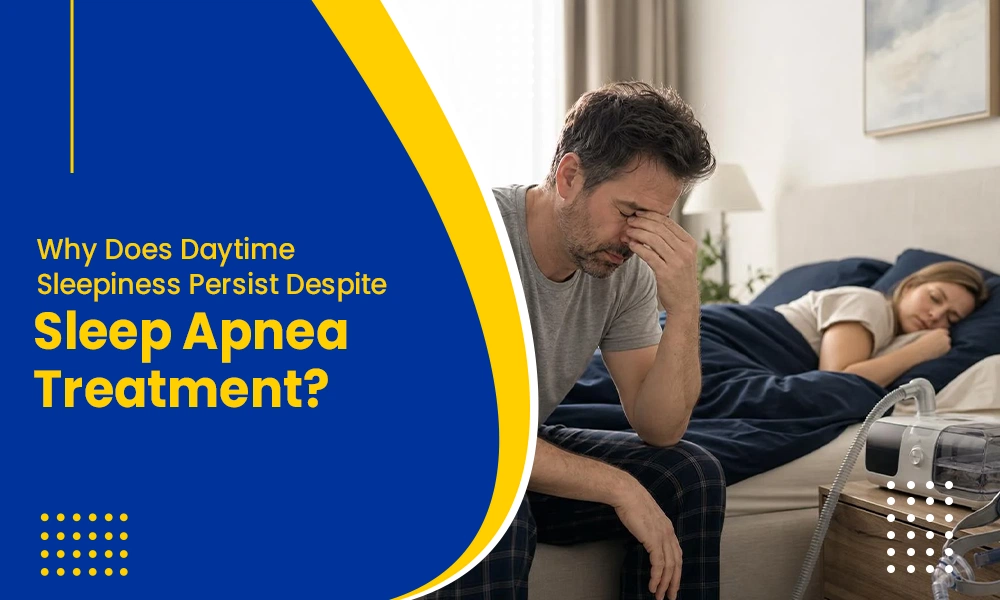
Daytime sleepiness is something that several people deal with, more so individuals with some form of sleep apnea, be it Obstructive Sleep Apnea (OSA), Central Sleep Apnea (CSA), or mixed sleep apnea. Most people with any of these sleep apneas are suggested to start CPAP treatment. CPAP, or Continuous Positive Airway Pressure, is a device that’s used to deliver a consistent stream of pressurized air that’s transported through a mask. This stream of air helps keep the person’s airways open.
Now, CPAP should ideally work for your apnea. Just imagine cleaning up the windshield of your car for a journey only for it to end up foggy again. It’s definitely a frustrating situation to be in. You did what you were supposed to, and yet the problem doesn’t let up. This is similar to what people with sleep apnea experience for whom their CPAP treatment refuses to work. CPAP should ideally be able to deliver more oxygen and reduce the breathing interruptions for sleep apnea patients, which should ideally give them better sleep. However, this apnea treatment may not always be the most effective for certain individuals, and their daytime sleepiness and fatigue may continue to persist.
Persistent Daytime Sleepiness Despite CPAP
The numbers tend to vary a lot when CPAP’s effectiveness is being studied. Some studies say roughly one in ten CPAP users stay very sleepy. Others land closer to one in four, mostly because they look at the early months. Hard to pin down, since every study measures it a little differently.
Usually it’s the Epworth Sleepiness Scale, a short questionnaire. Score above 10 out of 24, and your healthcare providers may start paying attention. In the papers this shows up as sleepiness despite CPAP treatment, or residual excessive daytime sleepiness.
One detail worth holding onto is that the first three months tend to be the roughest. Sleepiness is highest early on, then slowly drops for lots of people. So someone three weeks in might simply need more time. Obviously for some people that might not be the case, and they may actually have to look into their sleep apnea treatment.
Effectiveness of the CPAP Machine Is Evaluated
The first thing a sleep doctor usually checks is the typical stuff. Is the mask leaking? Is the pressure of the machine set right? Is the machine worn long enough each night? Under four hours generally doesn’t cut it.
Sometimes the numbers look great, and the sleep is still chopped up by tiny arousals that a basic home report never catches. Some people also develop central apneas after starting pressure therapy, which sounds backwards, but it happens.
And then there’s apnea that clusters in REM sleep, the dreamy stretch that piles up toward morning. If the pressure or the hours don’t cover that late stretch, a big chunk of the night can still be a mess.
So sleep apnea treatment effectiveness isn’t only about whether the mask was on. It’s about whether the whole night actually got repaired. Different question, harder answer.
Other Conditions Leading To Daytime Sleepiness
This part catches people off guard. Sleepiness has a ridiculous number of causes, and apnea is only one. A person can have apnea and something else sitting right beside it, and CPAP handles just the one.
Restless legs and limb movements during sleep show up a lot. In one clinic review of CPAP users who stayed sleepy, nearly half had restless legs. Depression also explained another big slice. Low mood and sleepiness overlap so much that pulling them apart gets tricky.
Medications can play a role too. Antihistamines, some blood pressure pills, certain antidepressants, and sleep aids. Any of them can make a person drowsy all day, and nobody links it back.
There’s also thyroid trouble, low iron, diabetes, and heart problems. It’s a long list, honestly, and these are all causes of daytime fatigue that have nothing to do with a collapsing airway.
Daytime Sleepiness vs. Just Feeling Tired
Small side note that gets missed a lot. Being worn out and being sleepy are different things, even though people use the words like they’re interchangeable. The state of tiredness is heavy and drained; there is essentially no energy for anything. Sleepy is nodding off in a meeting, eyelids dropping halfway through a TV show.
Doctors care because the two point in different directions. Drained and flat often lean toward mood, thyroid, or something inflammatory. The nodding-off kind leans toward a sleep problem. You may accidentally blur the two concepts, which is a very understandable error, but since they may point to different issues, they have to be differentiated.
Sleep-Wake Disorders and The Brain
Now and then the sleepiness comes from a totally different problem. Narcolepsy is the one most people have heard of, and it can sit quietly next to apnea for years. Sudden muscle weakness set off by laughing or surprise, called cataplexy, is one clue, though not everyone gets it.
Sleep-wake disorders as a group are a messy bunch, and a sleep specialist is usually the one who can untangle them. A daytime nap study, or another overnight test, sometimes gets ordered for exactly that reason.
There’s a less comfortable idea too. Years of untreated apnea mean years of oxygen dips and broken sleep. Some researchers think that may leave lasting damage in the parts of the brain that keep a person awake, including the orexin system. Not proven. The literature still calls the mechanisms unclear.
But it would explain why somebody with perfect machine data still drags through the afternoon. And it’s a decent reason why “just use the CPAP harder” doesn’t always work.
Lifestyle Habits Leading to Daytime Sleepiness
Lifestyle gets overlooked a lot. A person finally has a working night with the machine, feels a little better, and goes right back to staying up. Scrolling at night is a big one. Phone in bed, one more video, one more, and suddenly it’s 1 a.m. with an alarm set for 6. Even decent apnea treatment can’t fix a five-hour night.
Same with late caffeine, irregular schedules, and shift work. Alcohol deserves a mention too, since it relaxes the throat muscles and can bring the apnea back while chopping up sleep anyway.
Diagnosis After CPAP Has Started
The classic obstructive sleep apnea symptoms are loud snoring, gasping at night, morning headaches, dry mouth, brain fog, and daytime sleepiness. After starting the machine, the snoring and gasping usually fade quickly. Sleepiness lags behind.
So when it hangs around, a doctor has to work out whether it’s leftover apnea, a second condition, or the after-effect of years without help. Daytime drowsiness after CPAP therapy can be any of those or a mix of them.
That’s also why persistent daytime sleepiness shouldn’t get brushed off with “give it time.” Time is part of the answer. Not all of it.
What’s The Treatment Procedure
However, there’s no single fix. Medical professionals usually start by pulling the CPAP data, checking the mask fit and the pressure, and deciding whether a repeat sleep study makes sense. Then bloodwork, a medication review, and a screen for mood problems and restless legs.
For managing daytime sleepiness day to day, small stuff counts. Fixed sleep and wake times. A short nap early in the afternoon, twenty minutes tops. Morning daylight. Caffeine before noon. Moving around when the slump hits.
If everything has been checked and the sleepiness still sticks, a sleep specialist may talk about medication that promotes wakefulness. That’s a doctor’s call tied to a proper diagnosis. Not something to start alone.
Final Thoughts
Apnea treatment fixes the breathing. It doesn’t promise to fix every reason a person feels sleepy. Those are two separate jobs, and mixing them up is where a lot of frustration comes from.
If the mask is on every night and the afternoons still feel like wading through mud, that’s worth a real conversation with a doctor. A sleep clinic, ideally. Apnea treatment may need adjusting, or the sleepiness might be coming from somewhere else entirely, and finding out which one is the whole point.