Have you ever walked into a room and instantly forgotten why you went there in the first place? Yeah, happens to the best of us. So many of us, on a daily basis, go through this experience. Of course the next best action is to go back to your original place and try to somehow recollect what your brain has forgotten. This is a common experience and a very normal one at that. You wouldn’t be that worried about your memory. The problem arises when you constantly keep forgetting stuff or constantly feel like your brain is in the backseat, and you’re just watching life pass by. That is when you must probably intervene.
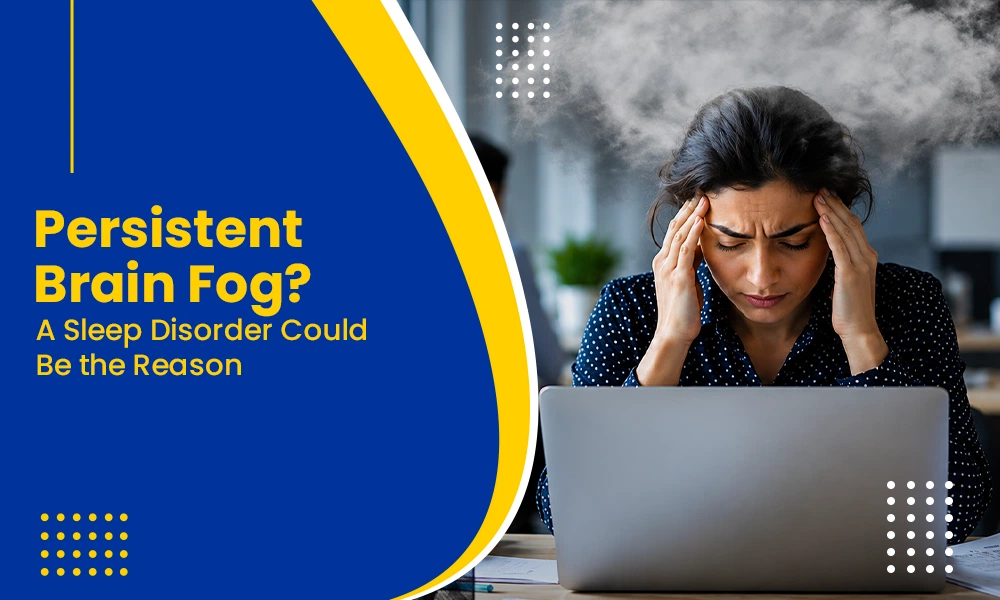
So many individuals claim that their head feels like it’s stuffed with cotton wool by 3pm every single day, and honestly, that’s about the best description going. That’s brain fog. Not a diagnosis, not really a “condition” on its own, more like a symptom that shows up wearing different disguises depending on what’s actually wrong underneath.
Most people blame stress first, or too much screen time, or just getting older, which, fair enough, sometimes that’s part of it. But there’s a decent chance the real culprit is sitting somewhere in how a person sleeps, not how much coffee they drink.
The fog isn’t random
Brain fog tends to follow a pattern once someone actually pays attention to it. Worse in the afternoon. Worse after a bad night. Better, weirdly, on weekends when the alarm doesn’t go off at 6am. That pattern is a clue. It’s basically the body waving a flag and saying, hey, look at the sleep first.
Sleep deprivation and brain fog go together so often that sleep researchers barely treat them as separate topics anymore. This kind of brain fog from poor sleep isn’t something to just push past with a second coffee, either, even though most people try. One rough night and thinking gets sludgy. String together a few rough nights, and it stops being occasional but becomes the baseline. People start thinking that’s just how their brain works now. It isn’t, usually.
There’s also a distinction that gets missed a lot, feeling foggy because sleep was short (say, four hours instead of eight) is different from feeling foggy because sleep was long enough on paper but broken up into fragments all night. The second one is sneakier. Someone might log eight hours in bed and still wake up feeling foggy because none of those hours were actually restorative.
When can it be considered a sleep disorder?
This is the part that gets skipped over a lot. People fix their sleep hygiene, use a dark room, avoid their phones, set a cooler temperature, and follow all the standard advice, and the fog barely budges. That’s usually the moment to start asking whether something structural is going on with the sleep itself.
Obstructive sleep apnea is the big one. The airway partially or fully collapses during sleep, breathing stops for seconds at a time, sometimes hundreds of times a night, and the brain never gets into the deep stages it needs. A lot of people with sleep apnea don’t even remember waking up gasping, a partner tells them, or they just notice they’re groggy no matter how “early” they went to bed.
Narcolepsy symptoms sometimes get mistaken for plain old grogginess too, especially in the early stages before anyone’s connected the dots. Sudden urges to sleep during the day, sleep that hits at inconvenient or even dangerous moments, and that heavy, foggy pull that coffee barely touches. It’s rarer than sleep apnea, but it’s underdiagnosed, partly because people just assume they’re lazy or unmotivated instead of dealing with something neurological.
Then there’s the whole circadian rhythm disorder category, which is basically the body’s internal clock being out of sync with the actual clock on the wall. Someone’s brain thinks it’s 3am when it’s actually 10am, and no amount of forcing themselves awake really fixes that mismatch. It happens with delayed sleep phase, with jet lag that never resolves, and with people who just naturally run on a different internal schedule than the 9-to-5 world wants them to.
Shift-workers bear the brunt
Anyone doing rotating shifts, night shifts, or that awful early-early-late pattern knows this already, probably better than any article could explain it. Shift work sleep disorder is basically what happens when someone’s work schedule fights their biology every single week and biology usually wins in the end, just not in a good way.
The fog for shift workers is relentless because there’s no clean fix. Sleeping during the day is never quite as restorative as sleeping at night, even with blackout curtains and white noise and all of it. So the sleep debt piles up quietly, and along with it, the fog gets thicker instead of clearing.
This is actually where a lot of people first hear about medications like modafinil or armodafinil. Both are wakefulness-promoting agents, not stimulants in the classic sense, and they’re used specifically in cases tied to that kind of shift work schedule, narcolepsy, or residual sleepiness from treated sleep apnea. Modafinil tends to be the more commonly discussed one, armodafinil is essentially its longer-acting cousin. Medications like Modaheal 100 mg or Modacare 300 mg contain modafinil, and medications like Artvigil 250 mg or Armodacharge 150 mg contain armodafinil as their active ingredient.
Both work on promoting alertness during waking hours rather than sedating someone at night, which is a distinction worth understanding since they’re not sleep aids, they’re the opposite.
Chronic fatigue vs. Brain fog
It’s worth separating tiredness from fog, even though in real life they blur together most days. Fatigue is a body thing, where you feel like your limbs are getting heavy, you have low energy, and you want to lie down. Fog is more of a brain thing, such as slow thinking, losing words mid-sentence, and forgetting why you walked into a room.
The two show up together so often that people just describe the whole mess as “exhaustion” without separating them. But treating only the tiredness and ignoring the cognitive piece means half the problem stays unaddressed. Underlying sleep disorders tend to drive both, just through slightly different mechanisms, so fixing the sleep issue often (not always, but often) improves both symptoms at once.
Symptoms of a sleep disorder
This is the bit people usually want to skip straight to. Sleep disorder symptoms worth paying attention to include loud snoring paired with gasping or choking sounds at night, waking up with headaches, needing to nap almost every single afternoon regardless of how much sleep happened the night before, and that specific kind of grogginess that doesn’t lift even after ten or eleven hours in bed.
Excessive daytime sleepiness is probably the clearest signal of all of them. Not “a bit tired”, but genuinely fighting to stay awake during meetings, while driving, mid-conversation, even. That’s not something to just push through with more caffeine. That’s usually the body asking for an actual sleep evaluation.
Brain fog on its own, without any of that, might just be diet or stress or dehydration, honestly. But that same fog stacked on top of snoring, or stacked on top of falling asleep at red lights, or stacked on top of a work schedule that never lets anyone sleep at the same time twice. That combination is where a sleep disorder becomes the more likely explanation.
So what helps?
Getting evaluated is the unglamorous but correct answer. A sleep study sounds like a hassle, and it kind of is, but it’s also the only way to actually know what’s going on instead of guessing. For diagnosed conditions like sleep apnea, treating the root cause, CPAP, weight management, positional therapy, whatever fits the case, usually does more for the fog than any amount of caffeine or supplements ever will.
For people whose daytime sleepiness sticks around even after the main sleep disorder is being treated, medications like modafinil and armodafinil sometimes enter the conversation as part of managing that residual sleepiness, always under a GP’s guidance rather than as a standalone fix. They don’t treat the underlying disorder itself, they help with staying alert during the day while the actual sleep problem is being managed some other way.
Modafinil and armodafinil are both stimulants which influence the dopamine, norepinephrine, and histamine levels in the brain. Both of them mainly work to increase the level of these neurotransmitters in the brain. The heavy, fatigued experience that you might remember of a brain fog is the feeling they work to combat and help an individual feel more alert and focused during their work hours or shifts.
Brain fog, at the end of the day, is rarely just about willpower or discipline. It’s the brain running on incomplete or broken sleep, and until that gets sorted, the fog tends to just sit there, coming and going, never fully lifting.
Frequently Asked Questions
1. Is brain fog the same as being tired?
Not exactly. Tiredness is physical, but fog is more about slow or fuzzy thinking, though they often show up together.
2. Can poor sleep alone cause brain fog?
Yes, even one bad night can do it, and ongoing poor sleep tends to make it worse over time.
3. Does sleep apnea always come with loud snoring?
Usually, but not always, some people have it without obvious snoring, which is part of why it’s underdiagnosed.
4. Are modafinil and armodafinil the same thing?
They’re related; armodafinil is a longer-acting version, but both work on promoting wakefulness rather than sedating.
5. When should someone see a doctor about this?
If fog and sleepiness are daily, affecting driving or work, or paired with snoring or gasping at night, that’s worth getting checked.